Salsa Dancing in Gym Shoes: Exploring Cross-Cultural Missteps with Latinos in the Classroom by Lavigne Alyson L. & Oberg De La Garza Tammy
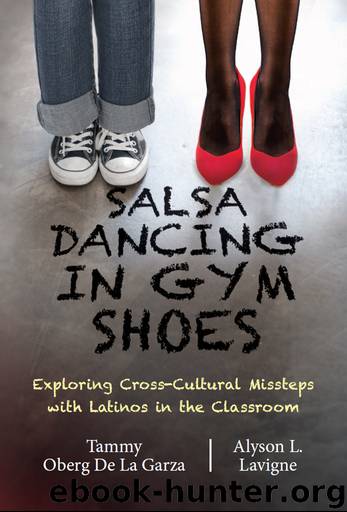
Author:Lavigne, Alyson L. & Oberg De La Garza, Tammy
Language: eng
Format: epub
Publisher: Advanced Classroom Strategies, Inc.
Published: 2015-01-21T16:00:00+00:00
Teachers must cultivate their personal attributes that enable them to champion the unique qualities of each individual, without taking into consideration gender, race, culture, language, social status, or value system. Without this characteristic, a teacher cannot effectively provide a just educational experience for all students.
LEVELS OF CULTURALLY RESPONSIVE INSTRUCTION
Equally important to academic advancement, providing opportunities for students to expand their awareness of cultural diversity and learn acceptance of others, is the responsibility of all teachers (Putnam, 1998). Differing levels of culturally responsive instruction can be woven into every aspect of classroom life, and it is the teacher’s responsibility to make intentional and deliberate decisions about the level and type of diversity in the curriculum that will set the tone for critical reflection, self-analysis, and change.
Three levels of culturally responsive instruction, from lowest to highest, include exclusive, inclusive, and transformed (Morey & Kilano, 1997). The exclusive level is bounded by a specific span of time and typically touches the surface four Fs of diverse cultures: food, fun, folklore, and fashion. The content of this level of diversity exploration is stuck at mainstream experiences that contribute to, rather than deconstruct, stereotypes. Instruction at this level is teacher-centered and typified with lecture, reading, and multiple-choice exams.
The inclusive level of diversity instruction remains teacher centered but widens the scope and adds some dimension by adding diversity but keeps it in contrast to the dominant norm. Content delivery may include use of guest speakers and texts authored by individuals with varying perspectives or social views. Instruction encourages students to employ critical thinking and peer learning to construct their own value systems.
Transformed levels of culturally responsive instruction challenges traditional views and encourages a change in thinking and seeing the world. It is no longer constrained by time (e.g., Hispanic Heritage Month); rather, it shows up in formal and informal activities across the academic time and space. Instruction is student centered, featuring service learning, problem solving, and/or student-created projects to address needs and answer intrinsic questions. Students learn from each other and an exploration of personal experiences. This may involve the exploration of vignettes of real-life situations where self-evaluation of examination of values can be employed. Self-reflection and assessment are characteristic of this level of instruction.
Download
This site does not store any files on its server. We only index and link to content provided by other sites. Please contact the content providers to delete copyright contents if any and email us, we'll remove relevant links or contents immediately.
The Art of Coaching Workbook by Elena Aguilar(51387)
Trainspotting by Irvine Welsh(21984)
The Secret History by Donna Tartt(19471)
Twilight of the Idols With the Antichrist and Ecce Homo by Friedrich Nietzsche(18782)
All the Missing Girls by Megan Miranda(16719)
Cat's cradle by Kurt Vonnegut(15557)
Ready Player One by Cline Ernest(15144)
Talking to Strangers by Malcolm Gladwell(13555)
Fangirl by Rainbow Rowell(9473)
The remains of the day by Kazuo Ishiguro(9223)
The Compound Effect by Darren Hardy(9159)
Thirteen Reasons Why by Jay Asher(9122)
Tools of Titans by Timothy Ferriss(8597)
Periodization Training for Sports by Tudor Bompa(8417)
Wonder by R. J. Palacio(8244)
A Court of Wings and Ruin by Sarah J. Maas(8116)
The Lover by Duras Marguerite(8052)
Change Your Questions, Change Your Life by Marilee Adams(7937)
Giovanni's Room by James Baldwin(7551)
